Current Events Watch: What Preppers Should Be Paying Attention To Right Now
The goal of preparedness isn't predicting the end of the world. It's recognizing developing situations before they become personal problems. Right now several events are worth watching—not because they guarantee a crisis tomorrow, but because history repeatedly shows that small disruptions can stack together and create larger consequences.
CURRENT AFFAIRS
DeVault Prepping
5/19/20263 min read
The goal of preparedness isn't predicting the end of the world.
It's recognizing developing situations before they become personal problems.
Right now several events are worth watching—not because they guarantee a crisis tomorrow, but because history repeatedly shows that small disruptions can stack together and create larger consequences.
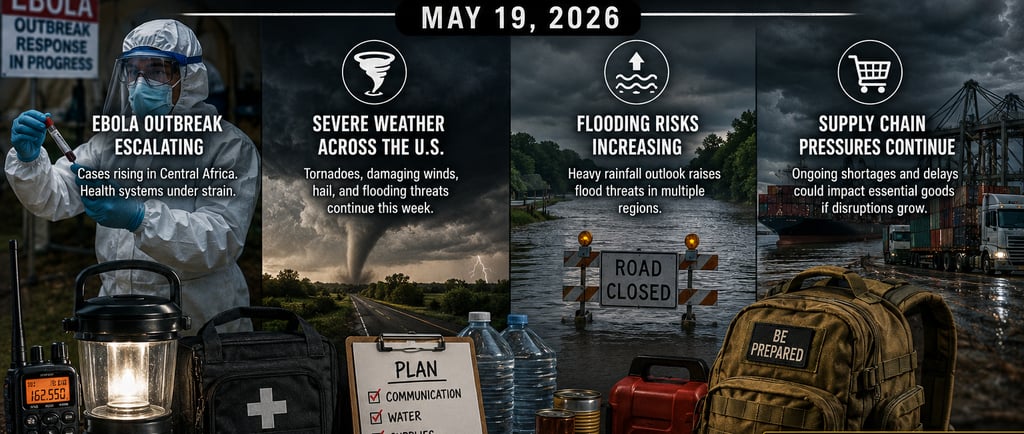
🦠 Ebola Outbreak Escalating in Central Africa
A rapidly expanding Ebola outbreak in the Democratic Republic of Congo and neighboring Uganda has triggered significant international concern. The outbreak is spreading faster than expected, with cases appearing in larger urban areas and healthcare systems facing strain. Health officials are evaluating experimental vaccine options because the specific strain involved does not currently have targeted approved treatments.
Why preppers should care
Most people immediately assume:
"That happened somewhere else."
Preparedness is usually less about direct exposure and more about second-order effects:
Travel restrictions
Medical supply shortages
Increased demand for PPE
Panic buying if media attention increases
Strained healthcare systems
Practical actions
Check expiration dates on masks, gloves, and medical supplies
Maintain at least a 2–4 week reserve of essential medications
Refill sanitation supplies before you need them
Avoid waiting until shortages appear
🌪️ Severe Weather Activity Across Large Parts of the U.S.
Millions of Americans remain under severe weather risk stretching from Texas through portions of the Midwest and Northeast. Tornadoes, damaging winds, large hail, and localized flooding remain concerns this week. More than 100 million people are in areas affected by severe weather patterns.
Why preppers should care
Weather remains one of the most common reasons people actually use emergency supplies.
Not EMPs.
Not zombies.
Not Hollywood scenarios.
Storms shut down roads, interrupt power, and create immediate problems.
Practical actions
Power
Charge battery banks
Test generators
Top off fuel supplies
Communications
Recharge radios
Update emergency contact lists
Evacuation
Review two primary routes
Prepare a backup route
Supplies
Minimum 72-hour emergency kit
Extra water stored and accessible
🌧️ Flooding Risks Increasing in Multiple Regions
Forecast outlooks continue showing elevated heavy precipitation risks in parts of the Southern Plains and Southeast over the coming days. Flooding often becomes dangerous because it develops quickly and catches people unprepared.
Why preppers should care
Flooding causes:
Road closures
Fuel access problems
Temporary food shortages
Property damage
Power outages
People often focus on storing food and overlook mobility.
If you cannot leave or supplies cannot reach you, preparation matters very quickly.
Practical actions
Keep vehicles above half a tank
Review alternate travel routes
Store important documents in waterproof containers
Verify insurance documentation is backed up digitally
What This Means Overall
None of these events alone automatically create a major crisis.
But preparedness isn't about one event.
It's about layers:
Disease monitoring
Weather awareness
Supply resilience
Financial readiness
Household systems
The people who struggle most usually aren't the least intelligent.
They're the ones forced to make decisions under pressure.
The objective isn't fear.
The objective is reducing dependence and avoiding last-minute panic buying if conditions change.
Ready to strengthen your supplies and preparedness systems?
Resources and gear recommendations:
https://shop.devaultcyberplus.com/product-category/prepping_products/
Or visit:
https://www.devaultprepping.com
Follow DeVault Prepping for practical preparedness and real-world readiness.
Semper Paratus (Always Ready).
Sources and Current Event References
Ebola Outbreak Monitoring and Response
Reuters — WHO concerned about speed and scale of Ebola outbreak as cases rise:
https://www.reuters.com/business/healthcare-pharmaceuticals/who-chief-concerned-speed-scale-ebola-outbreak-cases-rise-2026-05-19/
World Health Organization (WHO) Disease Outbreak News:
https://www.who.int/emergencies/disease-outbreak-news
Centers for Disease Control and Prevention (CDC) Ebola Information Center:
https://www.cdc.gov/ebola/
U.S. Severe Weather Monitoring
The Washington Post — Severe weather threats continue across the United States:
https://www.washingtonpost.com/weather/2026/05/19/threat-severe-storms-lingers-central-us/
National Weather Service (NWS):
https://www.weather.gov/
Storm Prediction Center (SPC):
https://www.spc.noaa.gov/
Flooding and Heavy Rain Outlook
NOAA Climate Prediction Center — Hazards Outlook:
https://www.cpc.ncep.noaa.gov/products/predictions/threats/threats.php
National Water Prediction Service:
https://water.noaa.gov/
Preparedness Resources
DeVault Prepping Resources:
https://www.devaultprepping.com
DeVault Prepper Shop:
https://shop.devaultcyberplus.com/product-category/prepping_products/
You may also want to add a short note above the source section:
"Current conditions and developing events can change quickly. These sources are provided so readers can monitor updates directly from news agencies and official organizations."
Preparedness
Empowering you to face any emergency situation.
Survival
Resources
© 2025. All rights reserved.